
Background
In a shocking turn of events, last December the European Commission announced it would review
and revise the Water Framework Directive (WFD), the EU’s flagship water law, by mid‑2026 in
order to promote “access to critical raw materials in the EU”. This is an extremely worrying move,
as such a revision threatens Europe’s waters and citizens’ health.
This sudden announcement came after months of intense lobbying by the mining industry in
Brussels, which has consistently called on the European Commission to expand the use of
derogations under the WFD to get a license to pollute water. The WFD does not prevent mining but
sets essential safeguards to protect water, ensuring it remains safe and clean during mining
activities.
Mining activities can take a big toll on local communities and nature. Beyond their social and
economic impacts, mining operations often lead to severe water pollution through the discharge of
mine effluent containing chemicals or heavy metals, which poses serious risks to wildlife and water
quality. Indeed, numerous cases in Europe – from Spain and Sweden, to Romania – have shown the
devastating consequences of lack of legislation or the weak implementation of the WFD.
This briefing highlights emblematic cases, featuring exclusive quotes from those directly
affected, some of whom have travelled to Brussels to personally call on the European
Commission to refrain from revising the WFD and from repeating the same mistakes that led to
terrible socio-cultural, economic, and environmental disasters.
Cases across Europe
Baia Mare, Romania – A second Chernobyl
On 30 January 2000, a dam at a tailings lagoon of a gold mine near Baia Mare, in north‑western
Romania, broke, releasing 100,000 m³ of wastewater heavily contaminated with cyanides and
heavy metals into the Szamos (Somesul) river. According to official Romanian sources, the cyanide
spill caused interruptions to the water supply in 24 localities and led to additional public health
costs, as well as economic losses for local industry.
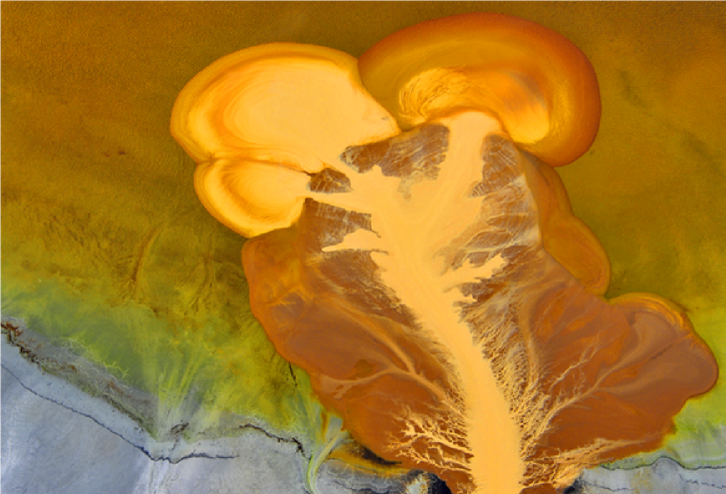
Traces of the toxic spill in Baia Mare, Maramureș County, Romania © Dr. Peter Lengyel
As a consequence, Hungary suffered damage of approximately USD 100–110 million in 2000, with severe impacts on local economies. The Australian‑Romanian joint venture responsible for the spill got away without having to pay compensation.
“The cyanide spill in Baia Mare in January 2000 was described as a ‘second Chernobyl’ because of its scale and the cross-border damage it caused. If the EU weakens environmental regulations—including water protection standards, public participation, and access to information and justice—similar disasters could happen again in Romania or elsewhere in the region.” Hans Hedrich, environmental and civil rights activist, Romania
Aznalcóllar, Spain – Disaster after disaster
It started almost 28 years ago, near Aznalcóllar in Andalucia, Spain, and its impact is still felt today. On 25 April 1998, a wall retaining mining waste by the “Los Frailes” zinc mine broke, spilling two million litres of water contaminated with heavy metals into and around the Agrio and Guadiamar rivers. Around 3,000 hectares of agricultural lands were affected, and all fishing, hunting, and grazing in the affected area was prohibited for more than half a decade after the disaster as a result.
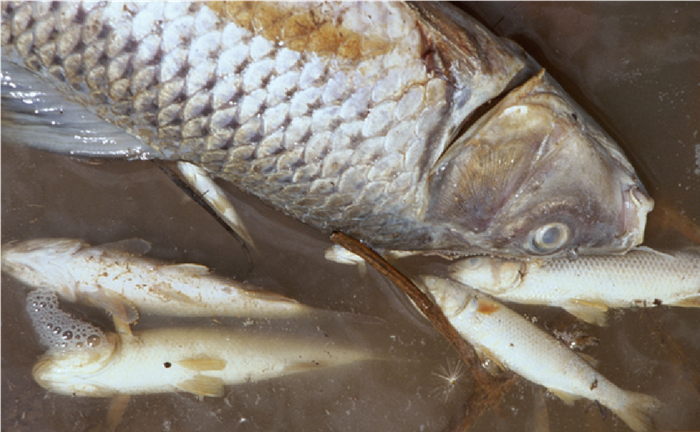
Dead fish in the Guadiamar River following the Doñana toxic spill © WWF-Spain / J.C. del Olmo
The operators of Cobre las Cruces, a nearby mine, were criminally convicted in 2016 for contaminating an aquifer with arsenic and breaching water regulations.
In 2026, Cobre las Cruces was also reported for heavy metal pollution in the Guadalquivir River, on which hundreds of fishers and farmers depend for their livelihoods.
“In Andalusia, we are well aware of the damage that modern mining can inflict on our natural resources. The nearby Aznalcóllar and Cobre las Cruces mines in Gerena are clear examples of how such activities can contaminate surface waters, wetlands protected under European environmental legislation, and even strategic aquifers used for human consumption. The Aznalcóllar disaster led to the discharge of toxic sludge and wastewater that came close to destroying the most important marshlands in southwestern Europe: Doñana. It also caused severe contamination in the lower basin of the Guadiamar River, the main ecological artery of the National Park. Andalusia urgently needs strong regulations to protect its natural resources from disasters like this.” Juan Jose Carmona, witness to the disaster and legal expert, Spain
* In a Communication published after the Aznacóllar and Baia Mare accidents, the European Commission wrote that “the recent mining accidents have illustrated a need for a review of Community environmental policy” and re-emphasised the relevance of the WFD, adopted shortly after, in that context. This Communication noted that the WFD “calls for measures at watershed level including measures required to prevent significant leakage of pollutants from technical installations, and reduce the impact of accidental pollution incidents, and systems to detect or give warning of such events”.
Ajka, Hungary- Villages destroyed, Danube tributaries poisoned by toxic red sludge
On 4 October 2010, a tailings dam at an alumina factorybroke in Ajka,Hungary, releasing over one million cubic metres of toxic red sludge. The contaminated sludge flooded the towns of Kolontár, Devecser and Somlóvásárhely, killed ten people, injured more than a hundred, and left 120 buildings uninhabitable.
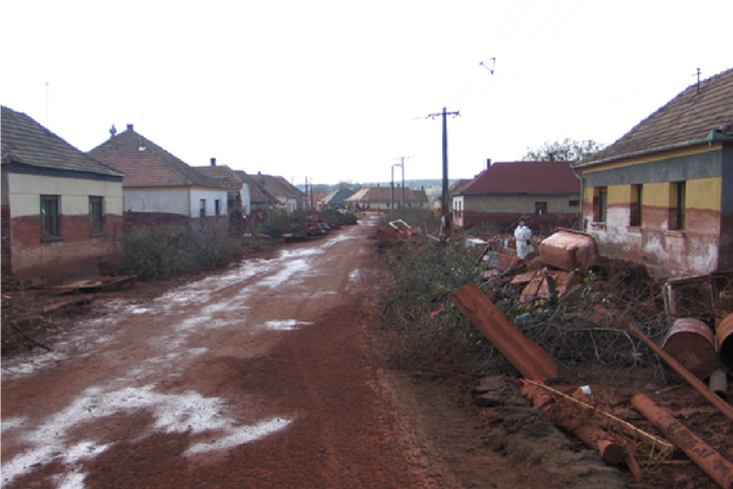
Streets flooded by toxic red sludge in Kolontár, Hungary
For months, towns downstream of the failed alumina tailings dam near Ajka remained ruined and largely deserted.
Residents and former residents hope that such disasters will never happen again in the region.
Oder, Poland – A river lost
In July and August 2022, saline waters discharged from coal and copper mining, in combination with heat and drought conditions, led to an algal bloom in the Oder River in Poland, killing up to 90% of fish and molluscs in the lowest part of the river.
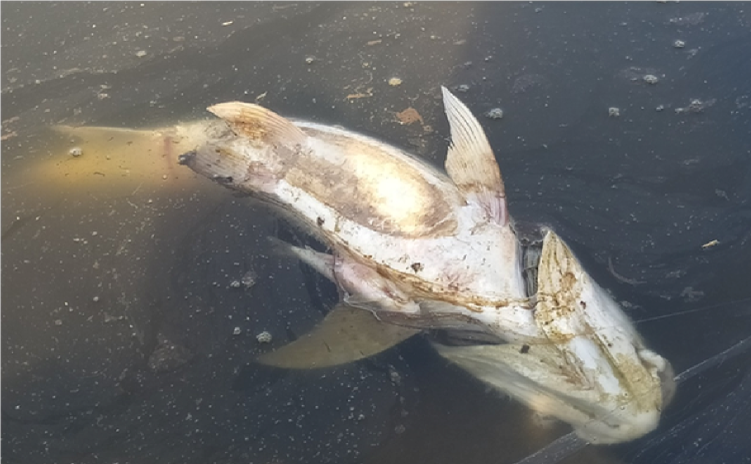
Dead fish in the Oder River, Poland © Ewa Drewniak
For several weeks, access to the river was officially prohibited, causing significant economic damage to the tourism sector. The poor implementation of the WFD (including inappropriate salinity thresholds for ensuring good ecological status) was among the factors leadingto the disaster.
Upcoming “strategic raw materials projects”
If the WFD is weakened to facilitate critical raw material extraction, new mining projects risk causing increased pollution and deadly consequences for local communities and nature.
Per Geijer mine & Nunasvaara graphite mine, Sweden – Disrupting local and indigenous communities’ culture and lives
Two mines in the Kiruna municipality have been designated as “strategic projects” under the Critical Raw Materials Act: the Per Geijer mine (near Kiruna town) and the Nunasvaara graphite mine (close to the village of Vittangi). Per Geijer is being developed by LKAB (state-owned mining company) and Nunasvaara by Talga.
Both companies are members of Euromines.
These projects pose a risk to the Torne River, one of the last rivers in northern Sweden that has not been exploited for hydropower. Torneälven is also a Natura 2000 area, protected under the Habitats Directive since 2000.
The Per Geijer project is located on the land of the Gabna sameby, a Sámi reindeer‑herding community. The Nunasvaara/Njunisvárri project is expected to impact the Gabna, Saarivuoma, and Talma sameby (legal entities for reindeer herding).
“When industry breaks the land apart, it divides our reindeer herds, undermines our culture, and silences our language.The land, its waters, and the reindeer, carry our history, our joik, and who we are today. If more is taken, the foundation of Europe’s only Indigenous people will be lost.” Simon Isak Marainen, member of Gabna sameby, Sweden
If you have any questions, please contact:
Alejandra Morales ,Communications Manager, WWF European Policy Office amorales@wwf.eu
Lionel Cheylus, Head of Media Relations, Surfrider Foundation Europe, lcheylus@surfrider.eu
Note to editors:
According to WFD Article 11.3(l), each EU Member State must elaborate a programme of measures for each river basin. This includes “any measures required to prevent significant losses of pollutants from technical installations, and to prevent and/or to reduce the impact of accidental pollution incidents for example as a result of floods, including through systems to detect or give warning of such events including, in the case of accidents which could not reasonably have been foreseen, all appropriate measures to reduce the risk to aquatic ecosystems.”
Surfrider Foundation Europe is supported by the LIFE programme created by the European Commission. The European Commission’s support for the production of this publication does not constitute an endorsement of the content, which reflects the views only of the authors, and the Commission cannot be held responsible for any use which may be made of the information contained therein.