
Coastal Risks: What Are We Talking About?

The shoreline is not a fixed boundary. It is a moving line, which humankind has long believed it could fix in place.
The climate, today, is reminding humankind of the opposite…

Coastal risks: what are we talking about?

Coastal erosion

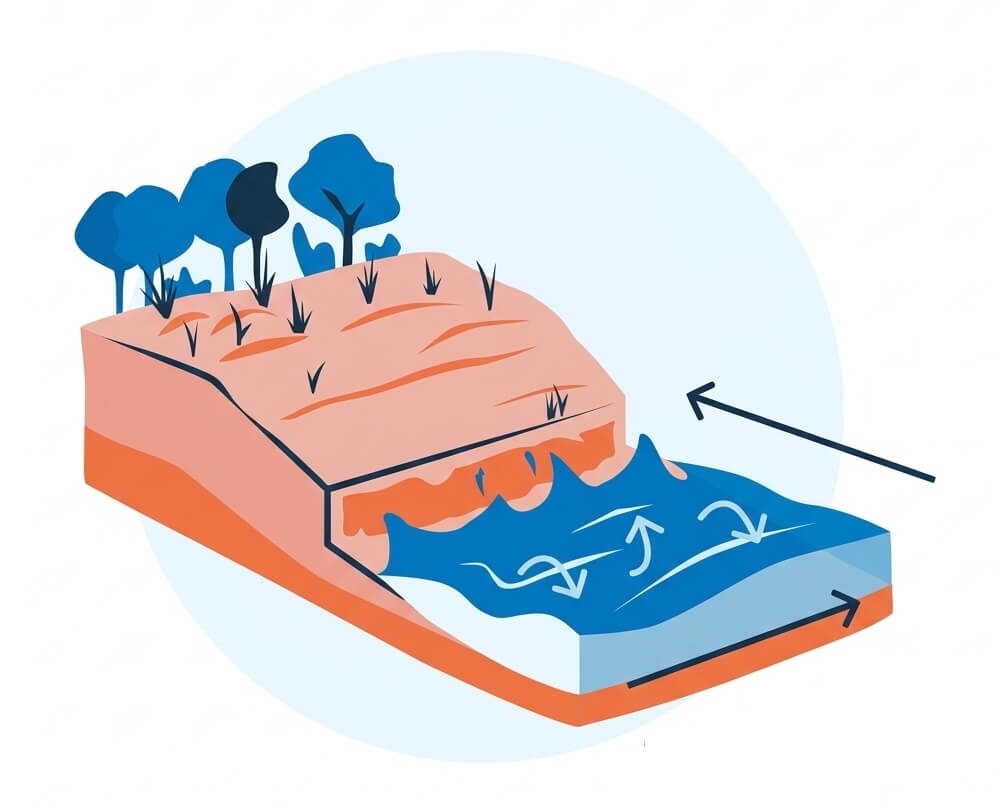
Coastal erosion is a natural phenomenon: the coast gradually recedes, and the boundary between land and sea, the well-known “shoreline”, moves inland. This process is caused by several natural elements such as wind, waves, ocean currents and rainwater runoff, which lead to a gradual loss of sand, rock and sediment.
Its pace depends on several factors: the nature of the ground (sand, hard or soft rock…), the slope of the terrain, but also the specific local features of the site.

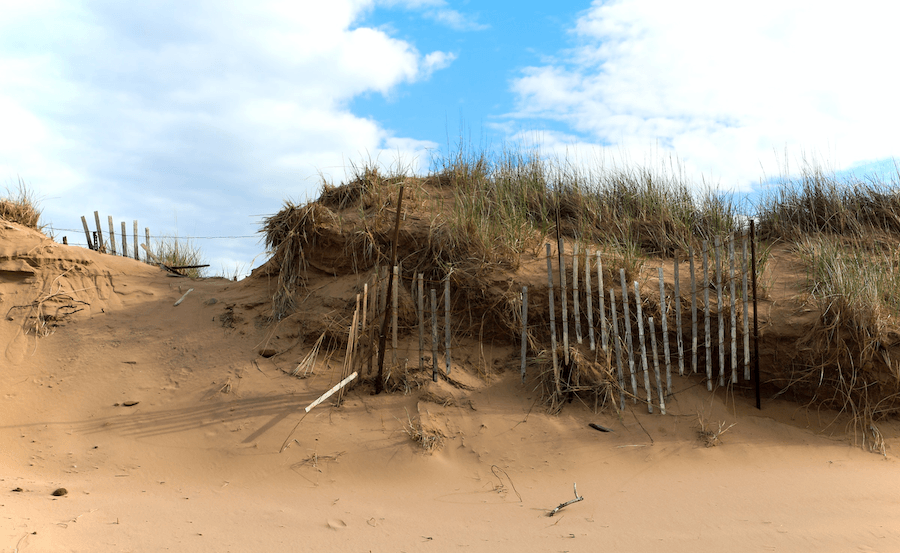
Sandy coasts are the most mobile and generally retreat faster. Wind pushes sand inland, while waves and currents carry it out to sea.
Under normal conditions, these movements balance out between winter storms, which carry sand away from the shore, and calm periods, which bring it back.
Some areas nevertheless erode in the long term when sediment supply no longer offsets losses, often because longshore drift carries sand along the coast.

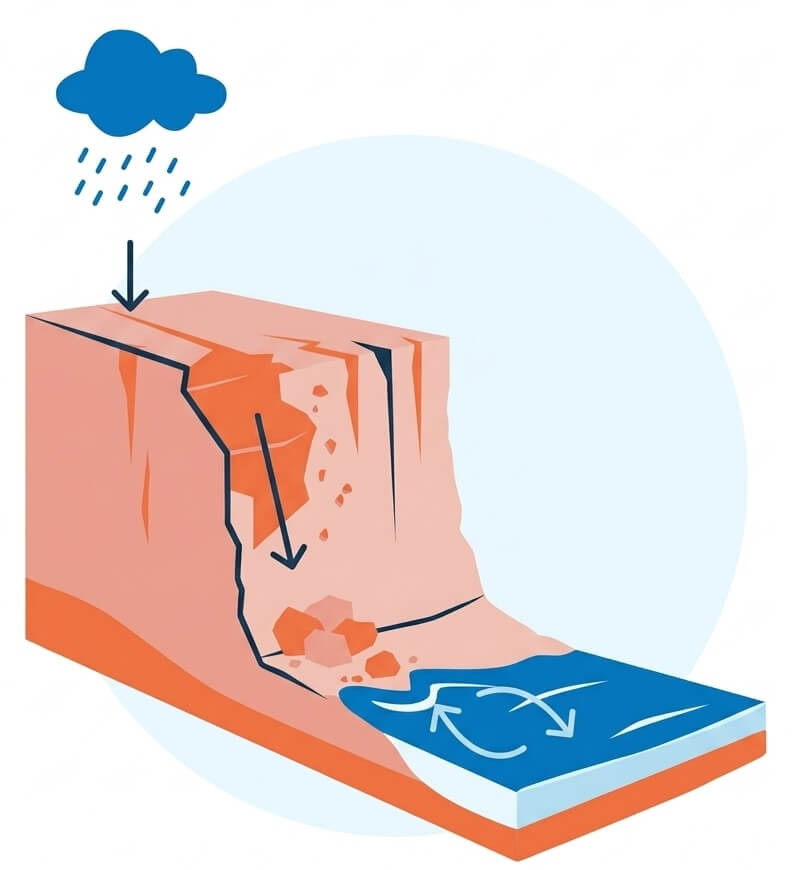
On rocky coasts, retreat is much slower, but continuous. Its speed depends mainly on the resistance of the rock: a granite cliff holds up far better than a limestone cliff.
Two mechanisms act together: rainwater seeps into the rock and opens cracks in it, while waves hollow out the base of the cliff.
This double action can cause entire sections to collapse.

While erosion is a natural phenomenon, human development of the coastline has changed its scale:

→ dams located upstream of coastlines, on major rivers, trap sediment that no longer reaches the coast,

→ the extraction of sand and aggregates from rivers reduces the amount of sand reaching beaches and the Ocean,

→ the concreting of the coastline and the loss of vegetation weaken natural barriers, such as dunes,

→ finally, some “sea defence” structures can disrupt sediment dynamics.

Marine flooding

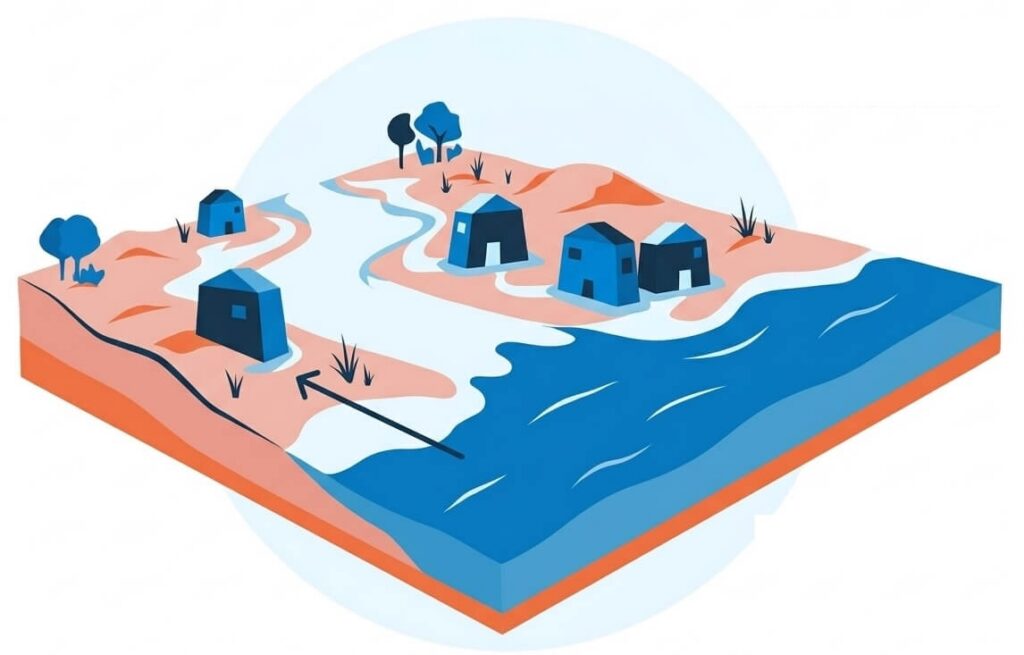
Marine flooding is a temporary flooding of coastal areas that are normally above water.
This natural phenomenon, rapid and often violent, mainly affects the coastline, particularly areas close to estuaries.
It can occur in three ways:

  • by overflow: the sea level exceeds that of the land or protective structures and spills directly over them.
  • by overtopping: waves break over coastal defences, whether natural or artificial, and send masses of water over to the other side.
  • by breaching: a dyke or a dune ridge gives way under the pressure of the water, causing sudden flooding.

Marine floods most often occur during a storm or a cyclone, which raise the water level near the coast.
Where the tidal range is small, however, these events can be enough to create dangerous water levels. Elsewhere, the risk is particularly high when it coincides with spring tides.

When do we speak of “coastal risk”?

A natural phenomenon becomes a coastal risk when it threatens environmental, human, economic, social or heritage stakes.
By settling too close to the coastline, without taking its natural dynamics into account, humankind creates a situation of vulnerability.
Coastal risk management then consists of limiting this exposure rather than denying the natural functioning of coasts.

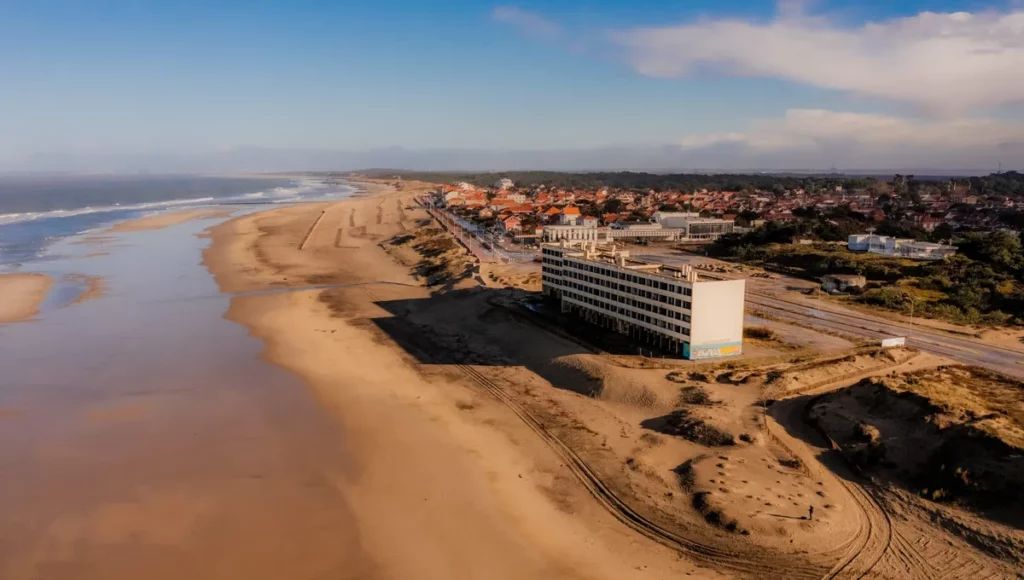
In France, the example of Le Signal building in Soulac-sur-Mer unfortunately illustrates this notion perfectly : it was built in 1967 on a dune, about 200 meters from the Atlantic Ocean, by 2018, it was only about ten meters from the water and had to be demolished in 2023.

Le Signal in Soulac-sur-Mer / © Maxppp - Guillaume Bonnaud / Sud Ouest

When climate change aggravates natural phenomena...

Climate change causes sea level rise and a multiplication of extreme weather events: two phenomena that directly contribute to the degradation of coastlines and the amplification of coastal risks.

The expansion of seawater due to heat, combined with the melting of glaciers and ice sheets, is raising ocean levels: since 1900, it has already risen by 20 cm, and is projected to stand 15 to 29 cm higher by 2050 than in 1995–2014, or even up to one metre higher by 2100 in the highest-emissions scenario.

This global rise raises the limit reached by the highest tides on the shore. Thus, during spring tides or storms, waves, starting from a higher level, hit the coasts harder. This phenomenon reinforces both erosion and marine flooding.

...and when artificialisation weakens the natural defences of coasts

Coastal risks do not depend on climate alone: the artificialisation of the coastline, by weakening the defences that would naturally protect the coast, also aggravates them.

Destroyed or weakened dunes and wetlands – yet these are the first natural bulwarks against the sea. A dune, a marsh or a lagoon dissipates the energy of waves before it reaches the land, by letting sediment absorb and cushion the impact. When these environments are urbanised, drained or cut off from the sea by dykes, this absorption capacity disappears: during a storm, waves and storm surge are felt more directly in inhabited areas, instead of dissipating over a natural space.

Localised protection structures – building rock revetments or dykes to protect a building paradoxically aggravates the problem elsewhere, by disrupting currents and accelerating erosion in neighbouring areas. During spring tides and heavy swells, the impact of waves on the coast is therefore doubly amplified: through the effect of climate, and through the effect of developments that have weakened the natural defences of the coastline.

Coastal risks: a measurable impact in Europe

Sea level in Europe is rising higher every year at an accelerating pace. Rising sea levels increase the risk of coastal floods and storm surges, coastal erosion and saltwater intrusion into groundwater. This presents an important threat to many coastal cities, regions and ecosystems in Europe.
Sea level will continue to rise for centuries or even millennia after global temperatures have stabilised (source: European Environment Agency, European Climate Risk Assessment, executive summary, 2024.).
Two fifths of the EU population (around 214 million people) live in a coastal region (Eurostat, 2017).

🇵🇹 Portugal

  • 25% of the mainland coastline is receding (Greenpeace report, 2026).
  • The average retreat of beaches is between 10 and 20 metres, and reaches 40 metres in some areas.
  • More than 100,000 people live in coastal areas threatened by flooding.
  • A separate estimate by the Portuguese Environment Agency (APA) puts the share of the coastline that is eroding at around 20% (180 km), and 14% of the population lives less than 2 km from the sea.

🇪🇸 Spain

  • Catalonia: 60% of the coastline is threatened by erosion, and Barcelona’s beaches lost more than 65% of their surface area between 1956 and 2019.
  • According to Greenpeace Spain, flooding could irreversibly transform the landscape at 194 points along the Spanish coastline by 2030.

🇳🇱 The Netherlands

  • A quarter of the territory lies below mean sea level, with some areas reaching 6.76 metres below, a record in Europe.
  • More than half of the population lives on land that is below sea level or exposed to flooding.
  • The country is protected by 17,500 km of dykes, dunes and barriers.

🇬🇷 Crete (Greece)

  • Nearly 70% of beaches are receding, while 90% of the island’s tourism depends on these beaches.

The development of shoreline management strategies

As erosion and marine flooding are set to intensify with climate change, coastal territories must learn to adapt to these natural hazards. To address them, local authorities are developing shoreline management strategies, based on solutions ranging from the most “grey” to the most “soft”.

Active defence: “grey” solutions
Dykes, rock groynes, rock revetments… These heavy, artificial infrastructures can fix the shoreline in place locally, but they often disrupt sediment movements, which can create problems elsewhere along the coast. Moreover, these constructions are expensive both to install and to maintain.

Supporting natural processes: “soft” solutions
At the opposite end, so-called “soft” or “flexible” management seeks to work with nature. These are mainly nature-based solutions, which preserve or restore coastal ecosystems (dunes, marshes, seagrass beds, mangroves…) to give them back their natural mobility and resilience.
Unlike hard structures, these solutions evolve with coastal dynamics and bring multiple benefits: biodiversity reservoir, carbon storage, improved water quality, etc.

Relocation, or strategic retreat
It consists of moving property or activities inland, away from the advancing sea. Its impact on the local population, however, cannot be overlooked.

Monitoring
It consists of regularly measuring the evolution of the shoreline without intervening. It does not prevent retreat and can therefore be followed by another strategy if necessary.

These approaches can be combined: the ideal is to favour nature-based solutions and to resort to grey infrastructure only as a complement, where strictly necessary.

THE EUROPEAN FRAMEWORK

“Among climate risks related to ecosystems, risks to coastal and marine ecosystems are the most severe in the current period and entail the highest urgency to act”.

This sentence, taken from the executive summary of the first EUCRA report, published in 2024, states an unequivocal finding: marine and coastal ecosystems face the most severe climate risks of all European ecosystems today, and are the ones where action is most urgent.

Yet, until now, no truly binding text has been adopted by the European Union to respond to this urgency. For example, the Marine Directive barely mentions climate change, thereby omitting to consider it as an additional pressure on coastal ecosystems, while the EU Strategy on Adaptation to Climate Change does not even mention the impact on the coastline.

This year again, 3 European strategies mentioning coastal risks (on coastal communities, islands and overseas territories) have been adopted by the EU.
However, none of them is binding in a way that obliges states to implement a set of measures to address the identified risks. These are merely guidelines.
Thanks, among other things, to the mobilisation of civil society, European legislation is tending to evolve, increasingly integrating the notion of climate change: 

  • The Nature Restoration Law is one of the first texts to make the link between “nature protection” and “climate change”. It sets a clear objective for the restoration of nature, identified as an indispensable bulwark against the impacts of climate change (among others), while specifically targeting the restoration of ecosystems with high carbon storage potential.
  • 2 other texts are expected to be presented soon to remedy this lack of obligations:
    → the revision of the Marine Strategy Framework Directive (MSFD)
    → and the long-awaited “European Ocean Act”, which is intended to be the translation into concrete measures of the European Ocean Pact and which, we hope, will more clearly integrate the impacts of climate change on the Ocean and coastal communities.
  • Finally, a major European text on adaptation to climate change, presented as the future European resilience framework, will be presented on 28 October. Among the announced elements is a legislative proposal that would require the EU and Member States to plan climate adaptation on the basis of a common reference scenario (+3°C by 2100), to designate a risk owner for each major climate risk and to adopt resilience plans for the most vulnerable sectors.

Surfrider Europe is closely following the announced texts and has been working, for several months/years, behind the scenes to steer European policies towards better integration … by notably calling for:

  • The prioritisation of actions to protect and restore coastal ecosystems in the face of coastal risks in States’ adaptation plans, together with the funding needed to deploy these nature-based solutions,
  • The drastic reduction of all pressures – pollution, coastal artificialisation, overexploitation, etc – that add to climate change, in order to allow coastal ecosystems to be resilient again and to fulfil their key role in climate change mitigation and above all adaptation,
  • And always and above all, the reduction of our greenhouse gas emissions!

Table of Contents

Get involved
for the Ocean

Your donation enables Surfrider to take concrete action every day
to protect the Ocean.

You may be interested in ...

When our photos become tools for monitoring the coastline: the CoastSnap initiative

Nature-based solutions: a sustainable response to coastal risks

Urdaibai: a biosphere reserve in danger

Climate crisis: the ocean is overheating, its temperature is breaking all records