
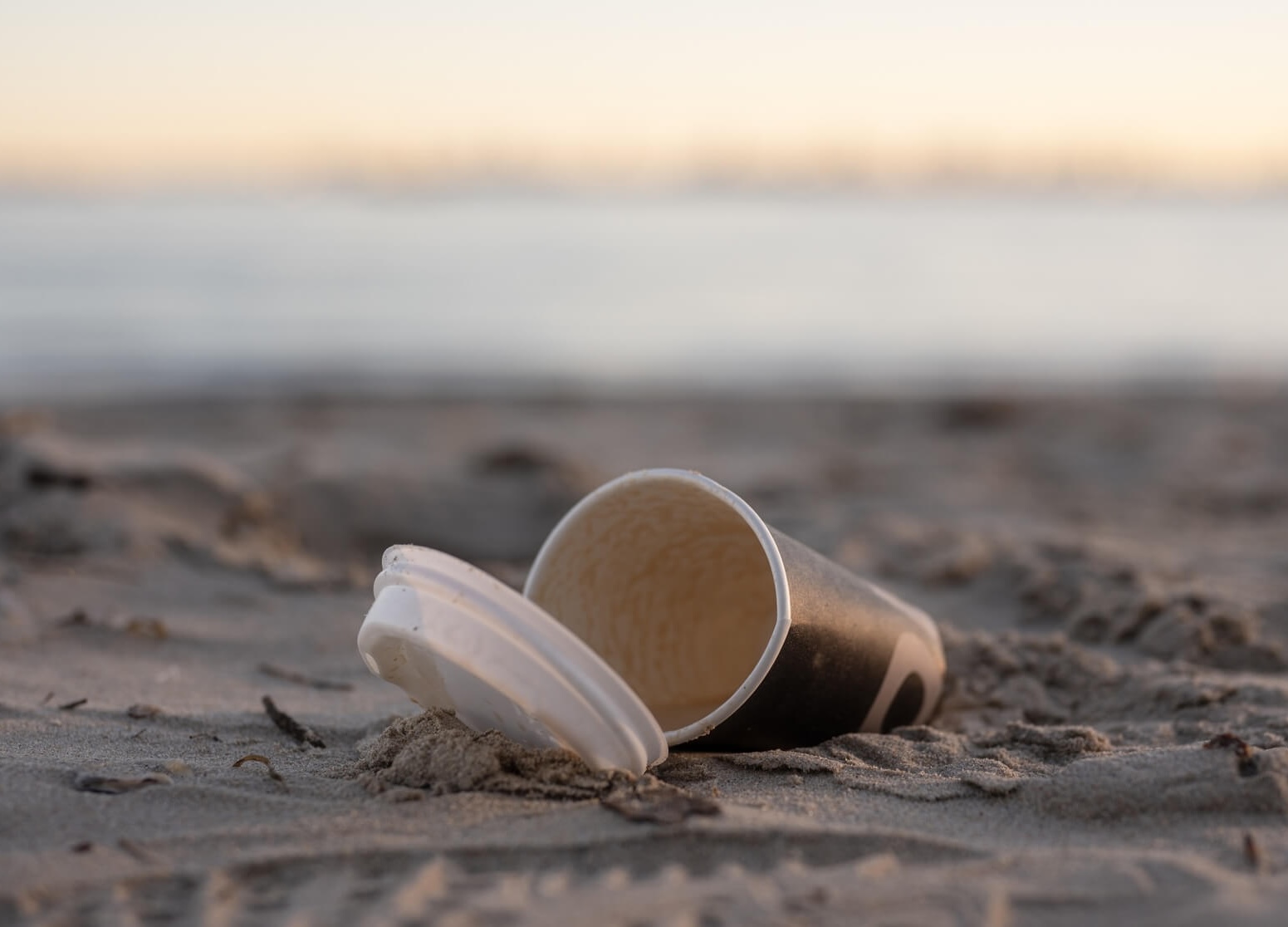
Cups, straws, plates and more: since many single-use plastic items were banned, paper and board have become the go-to “eco-friendly” or “natural” alternative.
Yet this disposable packaging also raises serious concerns for both the environment and human health. Here we take a closer look at five common misconceptions.
Find the key points of this article in our infographic 
Foreword: one plastic can hide another
Since 3 July 2021, the European Directive on single-use plastics (the SUP Directive) has banned many problematic single-use plastic products from the market.
Driven in particular by growing awareness of the impacts of plastic on aquatic ecosystems and human health, and long awaited by Surfrider, this legislation has removed several single-use plastic items from store shelves, including straws, cutlery, plates, stirrers and expanded polystyrene containers.
Unfortunately, new items that are just as disposable quickly took their place. Made from paper and board, bamboo or composite materials, these alternatives to plastic packaging and products are often marketed as “more sustainable” or even “natural”.
Yet these products, used for anywhere from a few seconds to a few minutes, also become waste that all too often ends up on beaches or in the Ocean, just like their plastic counterparts.
Replacing a single-use plastic product with a paper-based one is certainly not the answer to the major crisis of Ocean pollution.
Myth #1: “Paper and board are better for the environment”

False.
At first glance, paper and board seem “cleaner” than plastic, since they are made from wood pulp, a so-called renewable resource, whereas conventional plastic comes from petrochemicals and therefore from fossil resources. But renewable does not mean free of environmental impact.
Forests under pressure.
Producing paper means using trees, and therefore forests and the land they grow on. Rising demand for paper and board, particularly for packaging, has considerable impacts even before the final product is manufactured: land grabbing at the expense of local and Indigenous communities (as documented in Brazil, among other places), land-use conflicts, biodiversity loss (especially with monoculture plantations) and deforestation (when natural forests are cleared and replaced with fast-growing tree species).
Water, chemicals and energy.
Manufacturing paper and board requires large amounts of water, chemicals (to extract cellulose, bleach the pulp and strengthen the paper) and a great deal of energy. The pulp and paper industry is the world’s fourth-largest industrial energy consumer, accounting for around 5% of industrial energy use. According to the International Energy Agency, it emitted around 190 million tonnes of CO₂ in 2021, an all-time high.
Myth #2: “If it’s made of paper, it’s not plastic”
False.
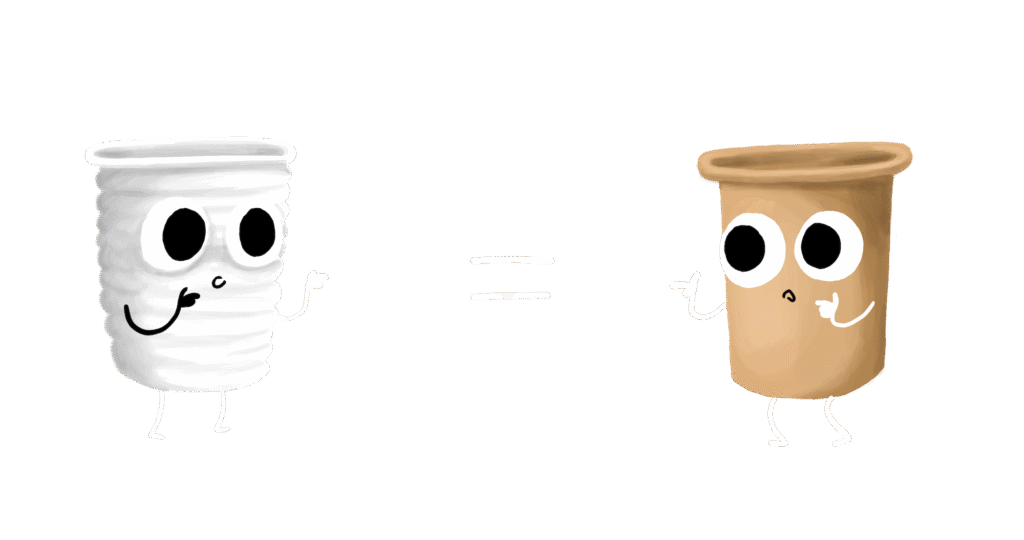
Just hold a piece of cardboard under a running tap to see for yourself: soaked within seconds, it becomes unusable. Paper and board are naturally porous and offer limited resistance to water and grease. For certain uses, they must therefore be given specific treatments or coatings.
Plastic to make it “functional”.
For a cardboard cup, tray or box to hold a drink or greasy food, manufacturers may add a thin layer of plastic: polyethylene or, increasingly, PLA, a “bio-based plastic” (which is still a plastic).
This is also the position of the European Union: according to the European Commission’s guidelines on the SUP Directive, a paper or board product with a plastic lining or coating is considered to be made partly of plastic.
So even if the paper breaks down in the environment, the plastic coating does not disappear at the same rate. It can persist and fragment into microplastics, just like any plastic product or packaging.
Right into our fridges.
Milk, juice and soup cartons are also composite packaging. A standard aseptic carton is made, on average, of around 70–75% paperboard, 20–25% polyethylene to prevent leaks, and up to 5% aluminium (Tetra Pak; Zero Waste Europe, 2020). The only material in contact with the food is plastic.
Myth #3: “It’s safer for our health”
Myth #4: “It must be better, because it’s recyclable”
False.
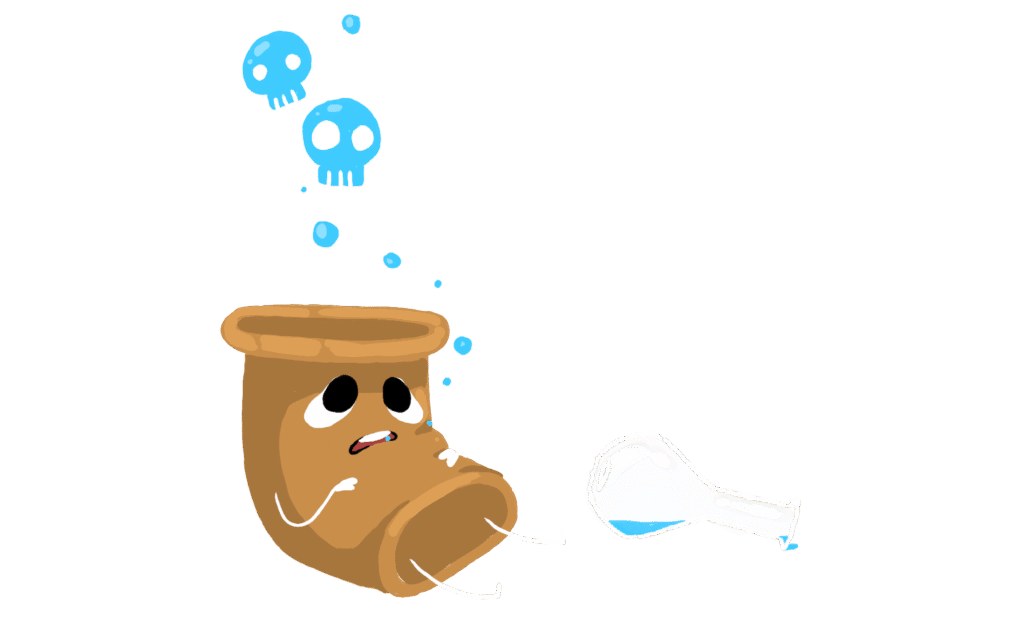
The vast majority of paper and board packaging intended for food contact is never made of paper alone. To make it waterproof and resistant to grease and heat, or to allow it to be printed, various chemical substances (additives, treatments and coatings) are added, and several studies have shown that these can migrate into food and drinks.
Substances of concern in paper straws…
A study published in 2020 in Food Additives & Contaminants identified 74 substances of concern in paper straws, two of which showed mutagenic potential and three carcinogenic potential. Another Spanish study measured the migration of 19 substances from paper straws into soft drinks, including two phthalates recognised as endocrine disruptors.
…and PFAS too!
In 2023, researchers at the University of Antwerp analysed 39 brands of straws made of paper, bamboo, glass, stainless steel and plastic sold in Belgium. PFAS were detected in 69% of the straws tested, and in 90% of the paper straws (Boisacq et al., 2023). These “forever chemicals” are used in particular to make straws, and paper and board products in general, water- and grease-resistant.
A recent regulatory step forward.
Since 12 August 2026, the EU Packaging and Packaging Waste Regulation (PPWR) has banned food-contact packaging from the European market when its PFAS content exceeds certain regulatory thresholds. This notably covers takeaway food packaging, bakery paper and pizza boxes. It is good news, but it addresses neither the issue of other substances nor that of waste.
False.
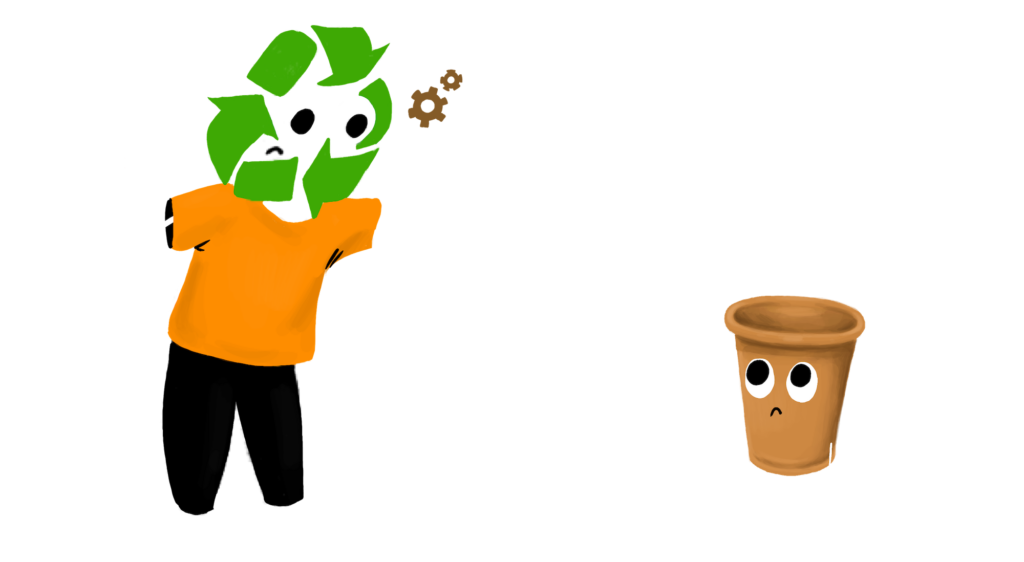
“Recyclable” packaging does not necessarily mean it will actually be recycled. And when it is littered or escapes collection and treatment systems, the fact that the paper layer breaks down faster does not mean it has no environmental impact, nor that the plastic layer will break down at the same rate!
Materials that are hard to separate.
Cups, trays and cartons may combine several materials (paper, plastic and sometimes aluminium) bonded together in different layers. To recycle them, the paper fibres must be separated from everything else, which most waste treatment facilities cannot do or are not equipped to do. Only around twenty specialised plants in Europe are able to process this “complex” waste (Zero Waste Europe, 2020). In these plants, only the board fibre is recovered and turned into lower-quality board. The plastic-aluminium mix is most often incinerated.
Persistent waste.
When poorly collected, paper-based packaging ends up in landfill, in incinerators or in the environment. The plastic component persists there and fragments into micro- and then nanoplastics, like any other plastic waste.
Myth #5: “There’s nothing we can do about it anyway”

False.
The underlying problem lies not only in the material used, but in an economic model built on disposability. And that model can be changed.
In response to new regulations, many brands have switched to packaging that looks more environmentally friendly. But paper and board packaging is, more often than not, merely a marketing argument designed to preserve a profitable linear model, rather than shift to a circular economy.
These products are not the way out of the pollution crisis, nor even out of our dependence on plastics.
Yet we can act, at several levels, to break this model and reduce the dominance of single-use items, largely imposed by manufacturers and their lobbies:
Public authorities
- Reduce at source, rather than making disposable items seem less harmful.
- Question the need for single-use items in cafés, offices, schools, events and takeaway services.
- Scale up reuse, especially deposit-return schemes, and support the organisations developing these solutions.
- Adopt a material-neutral approach: whether for plastic or paper and board, regulation must take into account the total environmental footprint, toxicity, actual recyclability and the overall reduction of single-use items.
Businesses and citizens
- Join and actively support the reuse systems that are emerging.
- Make reusables the normal, convenient choice: reusable containers, bulk sales, refills and solutions offered directly at the point of sale.
- Act alongside public policy, not instead of it: individual actions have the greatest impact when they help establish new norms and new infrastructure.
The real problem: single use
A product’s impact must be assessed across its entire life cycle: the materials it is made of, the substances added to it, how it is used and how it actually ends its life. Paper and board or plastic: the materials differ, but the impacts of disposable packaging remain heavy for both the Ocean and our health.
The solution is therefore not to switch materials, but to change the model: to move away from single use.
Find the key points of this article in our infographic